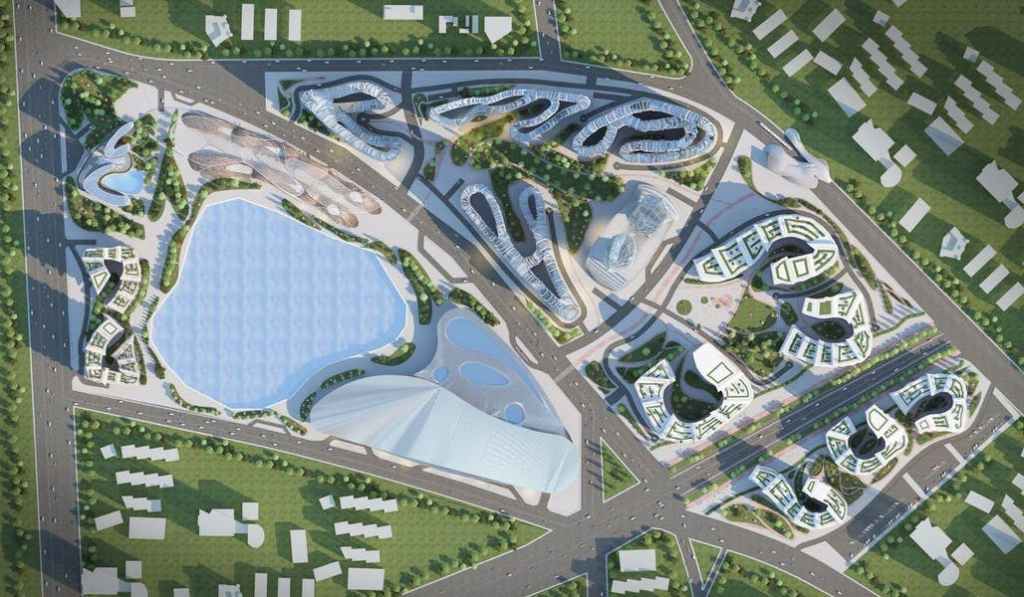
Akon, the musician and entrepreneur with dual Senegalese and American heritage, made waves worldwide with his ambitious plan to establish a modern, $6 billion smart city in Senegal, where his ancestors are from. Presented as a technologically advanced paradise driven completely by sustainable energy and featuring its own digital currency, “Akon City” aimed to revolutionize the area by merging technological advancements with economic prospects. Despite the initial excitement, years after the project was unveiled, it seems to have faced significant delays, with reports suggesting the city remains mostly uninhabited.
In 2020, Akon introduced his vision, sparking both enthusiasm and doubt. Taking cues from films such as Black Panther, he envisioned a modern city featuring tall buildings, luxury accommodations, a technology center, and eco-friendly systems. The city’s economy was to be driven by Akoin, a digital currency aimed at boosting African economies. Akon portrayed this initiative as an opportunity to create employment, encourage development, and represent African advancement.
The intended spot for Akon City was a 2,000-acre area situated on the Atlantic seaboard, close to the Senegalese village of Mbodiène. According to reports, the Senegalese government contributed the land, perceiving the initiative as a chance to enhance tourism, attract investments, and promote growth. Akon stated he had obtained financial backing from private investors and anticipated that the initial stage of development—comprising infrastructure, residences, and a police department—would be finished by 2023.
Nevertheless, as time went by, there was minimal physical advancement visible on the location. Reporters and community members who have been to the area have portrayed the land as mostly unchanged, with merely a modest sign indicating the prospective spot for the city. It has been reported that no significant building activities have occurred, and several of the bold commitments are still unachieved.
For the people living near the proposed development, the absence of progress has raised doubts and frustration. Some had anticipated new job opportunities, infrastructure, and tourism-driven benefits. Instead, they continue to live in villages with limited access to basic services, while the dream of Akon City seems increasingly out of reach.
The absence of noticeable progress has led to speculation about whether the project was ever financially feasible or overly ambitious from the start. Significant urban initiatives necessitate considerable, continuous funding and coordination—especially in areas where infrastructure remains under development. Certain analysts have highlighted the difficulties of initiating such a sophisticated city in a place lacking the essential groundwork.
Akon, on his part, has continued to affirm in interviews that the initiative is still ongoing, pointing to the COVID-19 pandemic and economic disturbances as major causes of its slow progress. He has stressed that constructing a city from the ground up is a complicated, lengthy task that necessitates thorough planning and resource management. However, despite these assurances, public confidence in the venture seems to have diminished as the anticipated advancements remain invisible.
The broader idea behind Akon City—using blockchain technology, green energy, and futuristic design to empower African communities—resonated with many who hoped for transformative change on the continent. Africa is home to some of the world’s fastest-growing economies, and young populations hungry for innovation. Akon’s vision aligned with a larger narrative of homegrown solutions and modern African success stories.
However, the actual implementation of these ambitious undertakings has turned out to be an entirely separate challenge. Akon City is not the initial major project on the continent to experience obstacles. Many proposed smart cities throughout Africa, including Kenya’s Konza Technopolis and Nigeria’s Eko Atlantic, have faced similar postponements, financial hurdles, or scaled-down plans compared to their original assurances.
El desfase entre ideales visionarios y realidades prácticas enfatiza los retos de ejecutar megaproyectos en economías emergentes. Problemas tales como la propiedad de tierras, financiamiento, asociaciones con el gobierno y obstáculos regulatorios pueden complicar incluso los planes mejor intencionados. Además, la mera magnitud de construir una ciudad futurista desde cero plantea desafíos logísticos que son difíciles de superar sin un apoyo considerable y constante.
For numerous people in Senegal, Akon City serves as a warning about ambitious pledges that don’t come to fruition. Although the musician’s desire to support his country and play a part in Africa’s future growth is well recognized, the absence of concrete advancements has caused disappointment among many.
The situation has also prompted broader conversations about how development should occur in Africa. Critics argue that large-scale, top-down projects often divert attention from more immediate, community-based solutions that could have a more direct impact on people’s lives. Rather than focusing on high-profile, expensive cityscapes, some advocate for investments in education, healthcare, small businesses, and existing urban centers.
Akon’s prominent participation drew global attention to the concept of Africa-driven innovation and the potential for economic development on the continent. Whether or not Akon City eventually becomes a reality, the conversation it initiated about Africa’s future, the role of technology, and the importance of infrastructure and investment continues to be valuable.
As of now, the proposed site remains largely empty, and timelines for construction remain unclear. Supporters of the project still express hope that the dream can be revived, while skeptics point to it as another example of overpromising without the means to deliver.
The tale of Akon City acts as a mirror to the ambitions and challenges of progress in Africa. It highlights the necessity of aligning forward-thinking concepts with realistic implementation, ensuring that the communities potentially impacted by these ventures are not left in prolonged anticipation for transformations that might not occur.
Although the future of Akon’s visionary metropolis is still unclear, its impact might be more in the discussions it initiated about how African countries can utilize innovation, technology, and entrepreneurship to determine their futures independently.